
support@yourdomain.com, MailBreeze captures it and delivers it to your application—via webhook, email forwarding, or the built-in inbox viewer.
How It Works
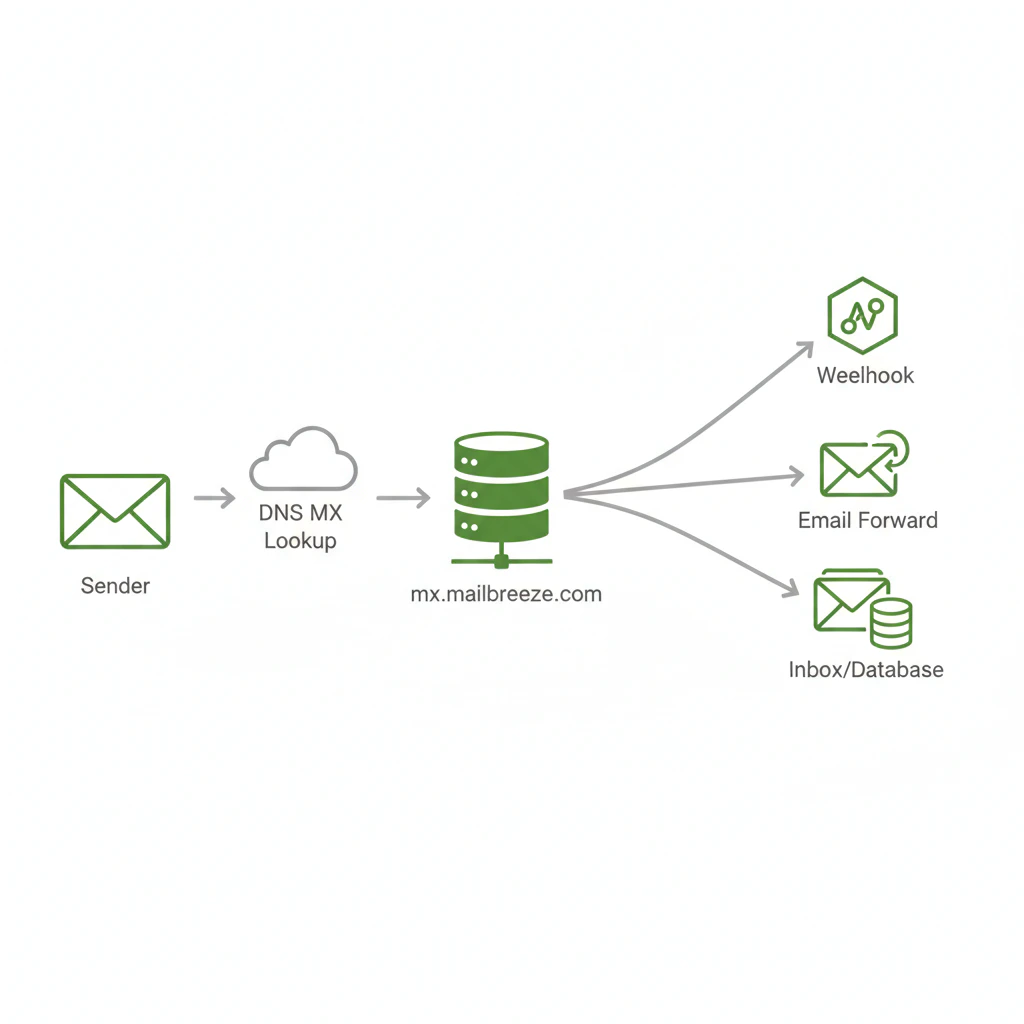
When you enable Inbound Email for a domain, MailBreeze becomes the mail exchanger (MX) for that domain:- Someone sends an email to
hello@yourdomain.com - Their mail server looks up your domain’s MX records
- The MX record points to
mx.mailbreeze.com - MailBreeze receives the email and processes it
- Your application receives the email via your configured delivery method
Use Cases
Customer Support
Route support emails to your helpdesk system via webhooks
User-Generated Content
Accept content submissions, form responses, or feedback via email
Email Parsing
Extract data from incoming emails (invoices, receipts, notifications)
Reply Tracking
Capture replies to transactional emails you’ve sent
Delivery Methods
When MailBreeze receives an inbound email, you choose how to handle it:Webhook Delivery
Send email data as a POST request to your server. This is ideal for applications that need to process emails programmatically—parsing content, extracting attachments, triggering workflows, or storing in a database.Webhook Payload Example
Attachment URLs require authentication. Include your API key when downloading attachments. URLs expire after 7 days.
Email Forwarding
Automatically forward incoming emails to one or more email addresses. This is useful when you want emails delivered to a team inbox (like a shared Gmail or Outlook mailbox) without building custom infrastructure. You can forward to:- Personal email addresses (e.g.,
ceo@gmail.com) - Team inboxes (e.g.,
team@company.slack.com) - Other ticketing systems that accept email (e.g., Zendesk, Freshdesk)
MailBreeze Inbox (Local Storage)
Store emails directly in MailBreeze and view them in the dashboard. This is ideal for:- Small teams that don’t need external email clients
- Reviewing emails before setting up webhook processing
- Archiving incoming messages for compliance
- Searchable by sender, recipient, subject, and content
- Retained for 90 days (configurable on paid plans)
- Downloadable as
.emlfiles
Supported Features
Limitations
- One MX handler per domain: Only MailBreeze can receive email for the domain. You cannot split email between MailBreeze and another provider (e.g., Google Workspace)
- No mailbox storage: MailBreeze is not a full email provider. Users cannot send emails from their inbound addresses
- Webhook timeout: Webhooks must respond within 30 seconds
- Retention limits: Emails in the MailBreeze Inbox are retained for 90 days by default
Next Steps
Enable Inbound Email
Configure MX records and enable inbound email for your domain
Configure Routes
Set up rules to route emails to different destinations
Webhook Integration
Process incoming emails in your application
API Reference
Retrieve and manage inbound emails via API